
Hashrate to Daily Bitcoin: The Calculator Inputs That Matter
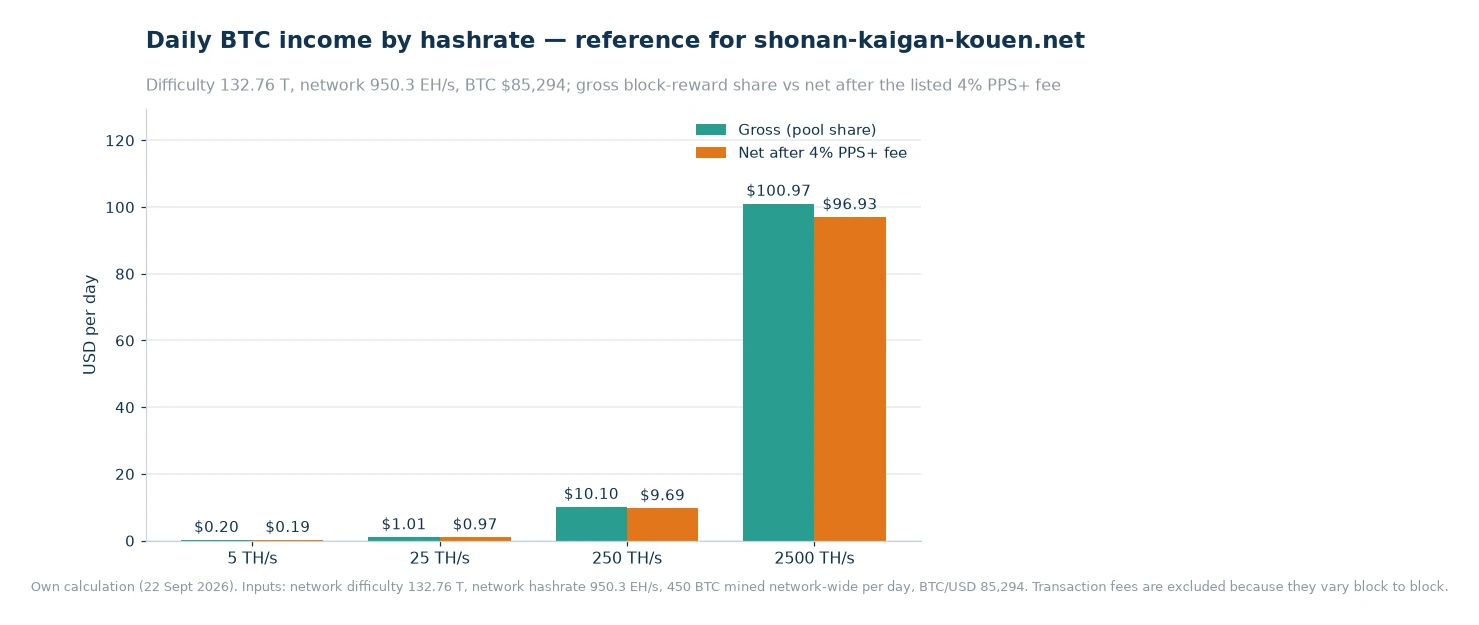
250 TH/s produces 0.00011838 BTC a day at difficulty 132.76 T, which is $10.10 at a BTC price of $85,294 and $9.69 after the listed 4% block-reward fee. It also means about 84 days of continuous running to accumulate 0.01 BTC. Convert hashrate into bitcoin first and dollars second, because only the first of those two numbers survives a price move.

Key takeaways
- 250 TH/s earns 0.00011838 BTC a day, about $10.10 gross and $9.69 after the listed 4% block-reward fee.
- 2,500 TH/s earns 0.00118384 BTC a day, so a 0.1 BTC target takes roughly the same 84 days as 0.01 BTC does at 250 TH/s.
- A difficulty rise of 1.90% lowers income per terahash by about 1.86%, taking 250 TH/s from $10.10 to roughly $9.91 a day.
- Network hashrate can be read two ways: 950.3 EH/s implied by difficulty, or 942.8 EH/s on an independent 3-day average.
Bitcoin first, dollars second
The calculator's job is a single ratio: your hashrate divided by network hashrate, multiplied by the 450 BTC the network issues each day, adjusted for the fee you pay. At 132.76 T, one terahash per second earns 0.0000004735 BTC a day. Multiply by your own hashrate and the answer is in bitcoin, which is the figure that will still be true next week if the price moves.
Reading the output that way also makes scale intuitive. Five terahashes earn 0.00000237 BTC a day, 25 TH/s earns 0.00001184, 250 TH/s earns 0.00011838, and 2,500 TH/s earns 0.00118384. The last two lines are the same number moved one and two decimal places, and so is everything else: hashrate scales linearly, price does not.
Why difficulty is the input that moves
Difficulty is the only input that changes without anyone touching your hardware. It currently sits at 132.76 T and the next adjustment is estimated at 1.90%. That estimate matters more than it looks: a 1.90% increase in difficulty means each terahash earns about 1.86% less, so $0.0404 per terahash per day becomes roughly $0.0397 on the day the change lands.
The network hashrate figure you feed the calculator is not unique either. Difficulty implies 950.3 EH/s, while an independent 3-day average of observed hashrate came in lower, at 942.8 EH/s. Using the second figure produces a slightly more optimistic estimate for the same machine. Neither is wrong; the point is to write down which one you used so the next run is comparable.
KAS shows how differently a dashboard behaves when blocks arrive fast. At 2.18 KAS per block and ten blocks a second, about 1,885,832 KAS is issued network-wide each day, worth roughly $80,768 at the current price, and pool figures move visibly within minutes instead of hours. On a chain like that the difficulty and hashrate you typed in can be stale by the time the page renders, so the useful habit is a fixed weekly run rather than an estimate taken on impulse.
| Input | Value in force | Effect on a 250 TH/s estimate |
|---|---|---|
| Your hashrate | 250 TH/s, entered as effective hashrate | 0.00011838 BTC a day, about $10.10 at $85,294 |
| Network difficulty | 132.76 T, next adjustment estimated at 1.90% | Per-terahash income is $0.0404 now and about $0.0397 after the estimated rise |
| Block subsidy | 3.125 BTC per block, 144 blocks a day | 450 BTC issued network-wide each day, which sets the ceiling for every share |
| Listed fee rate | 4% on the PPS-settled block reward under PPS+ | About $0.40 a day at 250 TH/s, leaving $9.69 |
| Uptime | Continuous running assumed by default | One hour off at 250 TH/s costs about $0.42 of gross output |
Worked example
Run 250 TH/s through the formula. Output per terahash per day is 0.0000004735 BTC, so 250 x 0.0000004735 = 0.00011838 BTC a day. Multiply by $85,294 to get $10.10 gross. The listed 4% on the block-reward component is 0.04 x $10.10 = $0.40, which leaves $9.69 net. Over 30 days that is 0.00355140 BTC, or about $290.70 at today's price.
Now use the same output to plan a target instead of a day. To accumulate 0.01 BTC at 0.00011838 BTC a day takes about 84 days of running; 0.1 BTC takes roughly 845 days. Shift ten times the hashrate and the targets move with it: 2,500 TH/s earns 0.00118384 BTC a day, grossing $100.97 and netting $96.93 after a $4.04 daily fee, and that reaches 0.1 BTC in approximately 84 days again. Re-run the 0.01 BTC target after a difficulty rise of 1.90% and the same 250 TH/s makes about $9.91 a day, stretching the target to roughly 86 days.
The same hashrate-to-target ratio works downwards. Twenty-five terahashes earn 0.00001184 BTC a day, so building 0.001 BTC takes about 84 days as well — the same span as 250 TH/s reaching 0.01 BTC, and the same again as 2,500 TH/s reaching 0.1 BTC. Pick the target first, then read the hashrate requirement off that ratio rather than guessing at machine counts.
Electricity converts on the same basis. A 2,500 TH/s group running 20 J/TH hardware draws 50 kW, which is 1,200 kWh a day and $72 at $0.06 per kWh, set against $96.93 of net income after the listed 4% fee. Merged-mining coins change the inputs rather than the method: LTC pays roughly $0.0805 per GH/s per day gross at a network hashrate near 2.71 PH/s, and the DOGE that arrives alongside it is merged output on top of the parent reward, so it belongs inside the total rather than in a separate calculation.
The inputs to enter, in order
Start with the ViaBTC Mining Calculator and enter four things: effective hashrate from your dashboard, the difficulty currently in force, the price you would sell at, and the listed fee rate for your payment method. On coins with merged mining, such as LTC where DOGE arrives alongside the parent reward, the estimate includes that merged output too, so treat it as part of the total rather than a separate line you have to model yourself.
Then confirm the two numbers the tool assumes rather than asks for. Pool hashrate and difficulty are visible on the Statistics page, and the pool's own luck over recent rounds is on the pool state view, which is worth reading whenever your credited output looks different from what the calculator suggested. Over a long window, luck averages out; over a single week it is the main reason two identical machines show different numbers.
Frequently asked questions
Should I use the difficulty figure or the network hashrate figure?
Either, as long as you record which. Difficulty (132.76 T) implies 950.3 EH/s, while an independent 3-day average came in at 942.8 EH/s, and the second figure produces a slightly higher estimate.
How much does a difficulty adjustment change my output?
The next adjustment is estimated at 1.90%, which lowers income per terahash by about 1.86%: 250 TH/s drops from roughly $10.10 to about $9.91 a day.
How long does 250 TH/s take to earn 0.01 BTC?
About 84 days at 0.00011838 BTC a day, ignoring difficulty changes during the period. Add roughly two days for every 1.90% difficulty increase along the way.
Keep the run and the date together
Save every calculator run next to the difficulty and price you used, because the output is only meaningful against those two numbers. Re-run it after each adjustment, and check the result against your credited output once a month; when they diverge, the cause is usually uptime or a hashrate figure taken from a machine label rather than a dashboard. Doing that turns a one-off estimate into a record you can compare from month to month.
Sources and references: the ViaBTC Profit Calculator[1] and listed fee schedule[2]. Network difficulty (132.76 T), implied network hashrate (950.3 EH/s), the 3-day hashrate average (942.8 EH/s) and BTC/USD 85,294 were read 22 Sept 2026. They are inputs to arithmetic rather than a promise of earnings, and they change with difficulty and price.