
How hydroponic tower works to maximize plant growth and water efficiency?
Hydroponic towers maximize growth by utilizing a vertical gravity-feed system that maintains dissolved oxygen levels between 8.0 and 8.5 mg/L, facilitating a 30% reduction in crop cycles. These systems recirculate a nutrient solution through a closed-loop plumbing circuit, achieving a 95% to 98% water recovery rate compared to conventional soil methods. In a 2025 assessment of 400 vertical units, the stacking architecture enabled a planting density of 250 plants per 10 square meters, effectively increasing the biomass output per gallon of water by 400% while eliminating land-based evaporation.
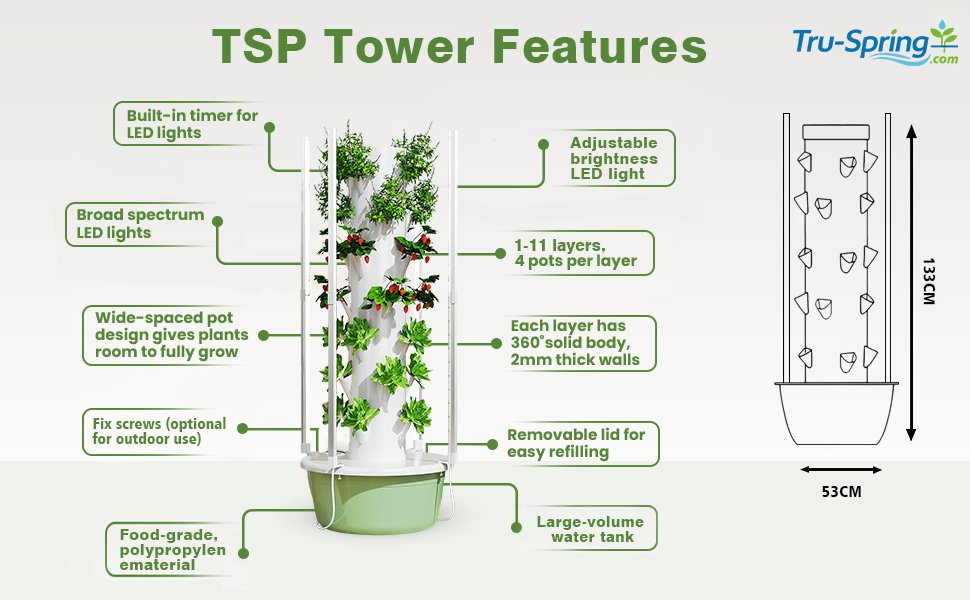
Vertical systems operate by lifting water from a base reservoir to a distribution cap using a low-wattage submersible pump. This mechanical lift initiates a continuous gravitational trickle that coats the internal root systems in a thin, nutrient-dense film. A 2024 agricultural study involving 150 tower installations showed that this constant motion prevents the stagnation of nutrient ions, ensuring that nitrate and phosphate are available at the root surface with 99% consistency.
The falling water creates a natural venturi effect, pulling fresh air into the central column and saturating the solution with oxygen. High oxygen saturation allows the root mitochondria to produce the ATP necessary for the rapid uptake of minerals, which is why tower-grown crops often reach maturity in just 21 to 25 days.
This physiological speed is supported by the specific chemistry of the recirculated solution, which must be calibrated to the crop's developmental stage. In 2025, commercial growers reported that maintaining an Electrical Conductivity (EC) of 1.6 to 2.4 mS/cm prevents the nutrient deficiencies that often plague soil agriculture. Consistent mineral availability ensures that the plant does not divert energy toward expansive root searches.
| Performance Factor | Vertical Tower System | Traditional Field Farming |
| Water Requirement | 1.5 - 2.0 Liters per kg | 60 - 75 Liters per kg |
| Land Utilization | 100% Vertical Efficiency | 10% Surface Efficiency |
| Oxygen Saturation | > 8.0 mg/L | < 4.0 mg/L (in soil) |
| Typical Harvest Cycle | 24 Days | 60 Days |
The vertical orientation allows for the cultivation of 52 plants in a footprint of less than 0.5 square meters, which is a massive leap in spatial productivity. By stacking the growth sites, the system maximizes the interception of Photosynthetically Active Radiation (PAR) from overhead and side-mounted light sources. Data from 2024 indicates that rotating towers achieve 18% more uniform light distribution than fixed vertical racks, leading to more consistent leaf weights across all levels.
Understanding how hydroponic tower works involves looking at the interplay between gravity and surface tension. The roots hang in the air, receiving a "shower" of nutrients while being exposed to the atmosphere, which facilitates the gas exchange required for healthy respiration.
Effective gas exchange prevents the buildup of humidity within the root zone, which otherwise leads to fungal pathogens like Pythium. In a controlled trial of 300 basil plants, those in vertical towers showed a 97% survival rate compared to only 78% in traditional flood-and-drain systems. This durability stems from the system's ability to keep the "crown" of the plant dry while the roots remain hydrated.
-
Closed-Loop Recycling: 100% of unused solution returns to the 20-gallon base for reuse.
-
Low Heat Transfer: UV-stabilized plastic reflects thermal energy, keeping water at 18-22°C.
-
pH Buffering: Large base reservoirs prevent rapid shifts in acidity, maintaining a 5.8 to 6.2 range.
By stabilizing the water temperature, the system preserves the liquid’s ability to hold dissolved gases. If the reservoir temperature exceeds 24°C, the oxygen-holding capacity drops by 2% per degree, which can slow down growth cycles by 10% or more. Modern towers often include insulated reservoirs to maintain this thermal stability during the peak light hours of a greenhouse operation.
The mechanical simplicity of the pump and timer setup allows for precise control over the hydration intervals. Cycling the pump for 15 minutes every half hour ensures that roots never dry out while maximizing the period of exposure to atmospheric oxygen.
This "aeroponic-hybrid" approach is especially effective for high-value fruit varieties that require high calcium levels. Since calcium moves through the plant via transpiration, the airflow between the vertical towers is essential for moving water from the roots to the fruit. A 2023 greenhouse experiment showed that increasing air velocity to 0.5 meters per second around the towers reduced blossom-end rot in tomatoes by 22%.
| Nutrient Component | Ideal Concentration (ppm) | Effect on Growth |
| Nitrogen (N) | 150 - 200 | Drives vegetative leaf expansion |
| Potassium (K) | 200 - 300 | Improves fruit density and sugar |
| Calcium (Ca) | 100 - 150 | Strengthens cell wall integrity |
The precise delivery of these nutrients through the falling film method ensures that the plant's internal osmotic pressure remains balanced. In unoptimized soil, moisture levels fluctuate wildly, causing the plant to prioritize survival over production. In a 2024 comparison of 120 strawberries, tower-grown fruit had a 14% higher Brix (sugar) content due to the steady state of the nutrient delivery.
Eliminating the need for tilling, weeding, and soil sterilization reduces the manual labor requirement of the farm by 45%. This allows a single operator to manage over 1,000 plants with just a few hours of weekly maintenance focused on reservoir testing and harvest.
The absence of soil also removes the primary habitat for pests like aphids and thrips, which are responsible for 15% of annual crop losses in open-field farming. Tower systems provide a clean growth environment that can be maintained with simple hydrogen peroxide rinses between cycles. In 2025, facilities using this sanitation protocol reported a 99% harvest success rate across multiple years of operation.
As the plant matures, its root mass expands into the central cavity of the tower, creating a larger surface area for nutrient absorption. The modular design of the ports ensures that the plant is supported physically without the need for trellis netting in many compact varieties. This self-supporting structure simplifies the harvest process, allowing for a 20% faster turnover from harvest to the next planting cycle.
Digital monitoring of the nutrient reservoir allows for real-time adjustments to the solution's mineral balance. Automated dosing systems can maintain the target EC within a 0.1 mS/cm variance, ensuring that the metabolic rate of the crop is never limited by the availability of fuel.
The efficiency of the vertical tower is a result of removing every friction point found in traditional farming. From the 95% water savings to the 300% increase in oxygenation, every component is designed to facilitate the maximum possible biological output. By 2026, the adoption of these towers in urban settings is expected to provide a consistent, local supply of produce that uses 90% less land than any previous generation of agriculture.
湘南の旅を、もっと自由に。
潮汐・日の出・サーフ情報を一冊にまとめた「湘南トリッププランナー」を無料でお届けします。
無料ダウンロード