
What 0.05 BTC Costs in Time at Four Hashrate Levels
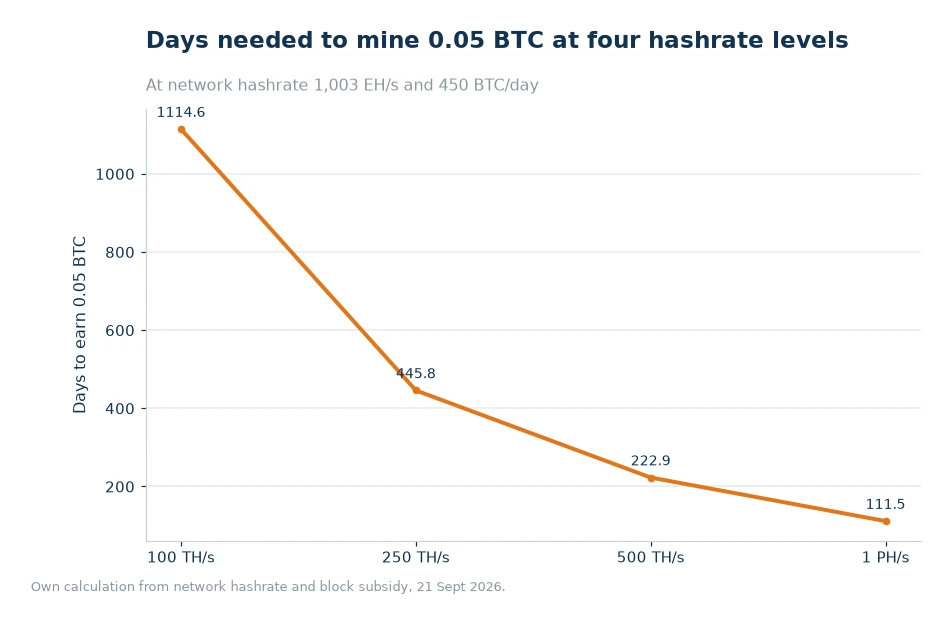
At 100 TH/s, 0.05 BTC takes 1,114.6 days — just over three years. At 250 TH/s it takes 445.8 days, at 500 TH/s 222.9, and at 1 PH/s 111.5. The target is the same in every case, worth $4,234.60 at $84,692 per BTC. The only thing that changes is how much of the network's 1,003 EH/s the miner controls, and that is a purchasing decision rather than a mining one.

Key takeaways
- 0.05 BTC takes 1,114.6 days at 100 TH/s and 111.5 days at 1 PH/s, a tenfold difference in time.
- 100 TH/s produces 0.00004487 BTC a day, worth $3.80 gross at $84,692 per BTC.
- Pool Hashrate sets block cadence; Pool Luck explains why a short PPLNS window can land above or below the model.
- Across a year at 250 TH/s the machine produces 0.040934 BTC, still short of the target.
Three years is a hardware lifecycle, not a waiting period
The 100 TH/s row is the one worth staring at. A 1,114.6-day schedule spans at least one halving, several generations of ASIC, and a power contract that will be renegotiated more than once. Planning a target across that horizon assumes the machine keeps running and the network does not grow much faster than the coins accumulate. In practice both assumptions are strained, which is why the row is better read as a warning than as a route.
At 1 PH/s the same target takes 111.5 days, inside a single quarter. Nothing about the pool changed between the two rows; the difference is entirely in the hashrate. That is the useful lesson from a table like this: targets are set by capital, and the pool's job is to price and settle the resulting output honestly. A miner who cannot fund the hashrate for a short schedule is usually better served by a smaller target than by a longer horizon.
How the days are built
Daily output comes from the ratio of your hashrate to the network's, multiplied by the 450 BTC issued each day. At 100 TH/s that is 0.00004487 BTC. Dividing 0.05 by it gives 1,114.6 days. Double the hashrate and the result halves; multiply by ten and it divides by ten. All four rows in the table below follow from that single number, 0.00000044865 BTC per terahash per day.
Difficulty then moves the denominator. The estimate on the read date was −2.12%, which would cut roughly 2.2% from each timeline if it lands: 1,114.6 becomes about 1,090 and 111.5 becomes about 109. A single adjustment is a rounding error against a three-year schedule, but the adjustments compound, and a year of small upward moves can add weeks to the long rows while barely touching the short ones. The direction of the estimate matters less than the habit of checking it.
Pool Hashrate, Pool Luck and the shape of a settlement
The ViaBTC BTC Mining Pool publishes both readings on one page. Pool Hashrate is the pool's share of the network, and it decides how often the pool finds a block. A pool with a large share finds blocks frequently, so each PPLNS settlement is smaller and arrives more regularly. A pool with a small share finds blocks rarely, so each settlement is larger and comes with longer gaps. The expected total over a year is the same; the experience of waiting for it is not.
Pool Luck is the ratio of blocks found to blocks expected over a window. It is a description, not a grade. A pool at 92% luck for a week found fewer blocks than its hashrate implied, which is entirely normal at that sample size. The reading becomes meaningful only when it is paired with the window length and the payment method. Under PPS+ the block-reward component is settled hourly against difficulty, so luck does not reach the miner's balance. Under PPLNS it does, and a long unlucky stretch is the cost of the lower listed 2% on both components.
The table, with a year for scale
The last column answers a different question from the days column: not when the target is reached, but what a year of continuous running produces at each size. For the two smaller rows, a year is not enough.
| Hashrate | Daily BTC | Days to 0.05 BTC | Output in 365 days |
|---|---|---|---|
| 100 TH/s | 0.00004487 | 1,114.6 | 0.0163776 BTC |
| 250 TH/s | 0.00011215 | 445.8 | 0.0409348 BTC |
| 500 TH/s | 0.00022433 | 222.9 | 0.0818805 BTC |
| 1 PH/s | 0.00044865 | 111.5 | 0.1637573 BTC |
The 250 TH/s row is the interesting one. A full year produces 0.0409348 BTC, about 82% of the target, so the schedule runs past the twelve-month mark and into the first quarter of the following year. That is the sort of detail a monthly income projection hides, and the reason a target-based plan is worth building at least once. It also explains why operators who quote annual output and operators who quote days-to-target often disagree while both being right.
Worked example
Take 100 TH/s, then scale the same arithmetic to the other three rows.
- Daily BTC per TH/s: 450 ÷ 1,003,000,000 = 0.00000044865.
- At 100 TH/s: 100 × 0.00000044865 = 0.00004487 BTC a day.
- Days to 0.05 BTC: 0.05 ÷ 0.00004487 = 1,114.6.
- At 250 TH/s: 0.00011215 BTC a day, and 0.05 ÷ 0.00011215 = 445.8 days.
- At 500 TH/s: 0.00022433 BTC a day, and 0.05 ÷ 0.00022433 = 222.9 days.
- At 1 PH/s: 0.00044865 BTC a day, and 0.05 ÷ 0.00044865 = 111.5 days.
- Dollar check: 0.05 BTC × $84,692 = $4,234.60 gross, or $4,065.22 after the listed 4% on the block-reward component.
The cost side of a long schedule
Time is only half the account. A 100 TH/s machine drawing 1.5 kW at six cents a kilowatt-hour spends about $65.70 a month on power, or roughly $2.16 a day, against $3.80 of gross daily output. Over 1,114.6 days that is about $2,407 of electricity for $4,234.60 of gross coins, before hardware. The margin exists but it is thin, and every difficulty increase or repair eats into it with no way to recover the hours already spent.
At 1 PH/s the picture is different mainly because fixed costs spread across ten times the output. Power scales with the machines, but monitoring, connectivity, cooling infrastructure and the operator's attention do not scale quite so linearly. That is why larger operations can remain viable at margins that would sink a single rig, and why the choice between a long small schedule and a short large one is partly a question of how much fixed overhead you already carry. A shed with one machine and a shed with twenty share the same roof, the same fan and the same monthly internet bill.
Frequently asked questions
Is 0.05 BTC a reasonable annual target?
At 250 TH/s a full year produces 0.0409348 BTC, so the target runs slightly beyond twelve months; at 500 TH/s the same target arrives in 222.9 days, comfortably inside a year.
Does a bigger pool make the target arrive faster?
No. Pool Hashrate changes how often blocks are found and how settlements are shaped, while the expected daily coin count depends on your share of the whole network.
How should I read Pool Luck on a three-year plan?
As noise. Over a window that long the reading converges toward expected blocks, and PPS+ miners are not exposed to it at all because settlement follows difficulty.
Match the target to the hardware you will still own
Before committing to 0.05 BTC, check how many days the machine needs and whether that span is shorter than the life you expect from it. If the answer is three years, either raise the hashrate or lower the target. The ViaBTC Profit Calculator will convert the daily coin figure into dollars at current price and difficulty, which makes the power comparison immediate and the decision less abstract.
Sources: the pool state page for Pool Hashrate and Pool Luck readings[1], and the published fee schedule for the listed 4%. Chain figures read 21 Sept 2026: network hashrate 1,003 EH/s, difficulty 132.76 T, 3.125 BTC per block, 144 blocks a day, BTC $84,692. Published 22 Oct 2026.